
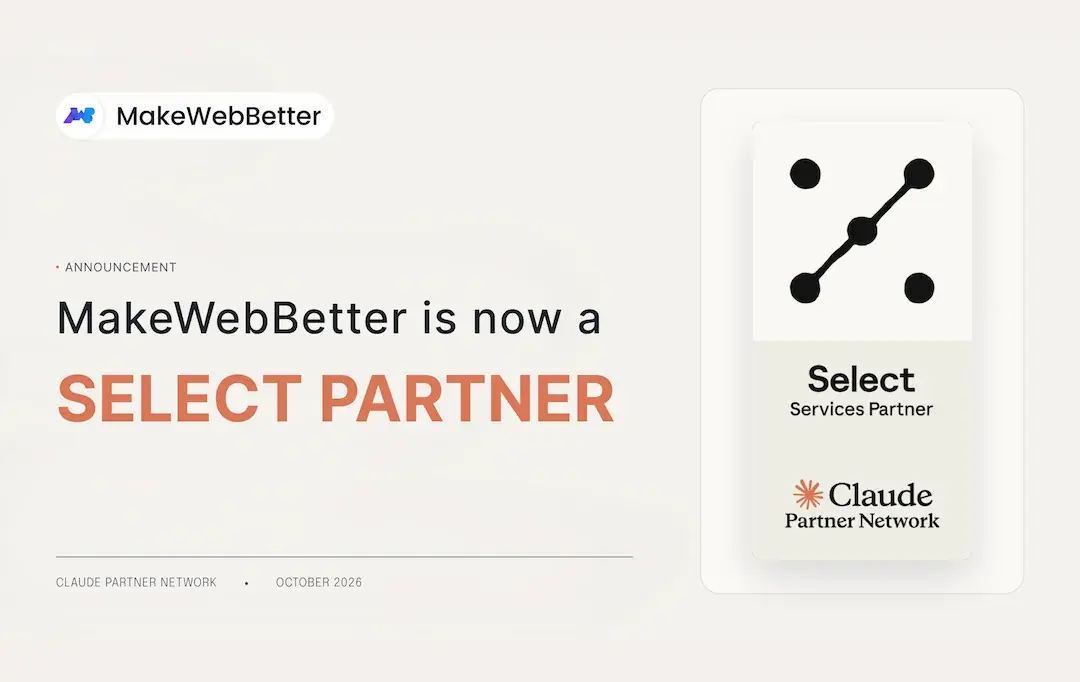
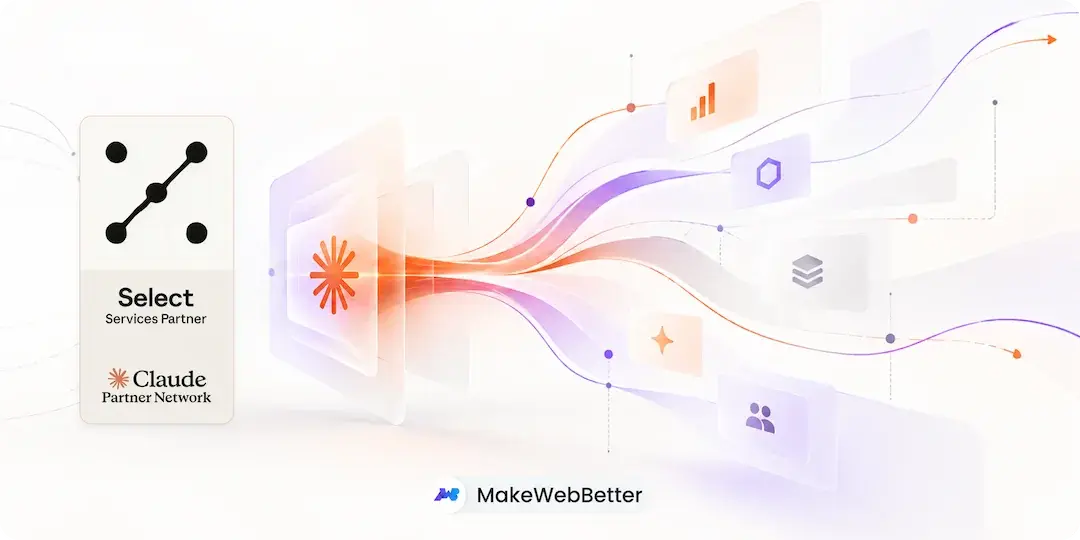
MakeWebBetter is now a Claude Select Partner. The Claude Partner Network membership expands our ability to help businesses move from AI experimentation to practical, production-ready systems and broader AI adoption as a certified Claude architect.
But the bigger story isn’t the partnership or our new badge.
It’s what we can bring to reality: Claude intelligence woven into your business operations.
Claude AI connected to the systems, workflows, knowledge, and decisions that already run your business.
We believe in that! This augments our ability to craft intelligence that lives in experience.
Claude Select Partner: Recognition For What We’ve Been Building
MakeWebBetter is now part of the Claude Partner Network as a Claude Select Partner.
Becoming an Anthropic Claude Select Partner is meaningful to us as it recognizes something we have already been working toward: helping businesses with AI transformations and intelligent, proactive capabilities to power through real-world business cases.
- Formal recognition of our growing capability as a Certified Claude Architect for highly sophisticated, enterprise-grade AI solutions, strengthening our ability to craft meaningful experiences for businesses.
- This means we are uniquely positioned to build complex, long-context reasoning systems, autonomous agentic automation, and deeply integrated applications that handle your most intricate operational challenges.
- For our clients, this means access to a broader capability to design, integrate, and implement Claude-powered intelligence and move beyond experimenting with Claude toward intelligence connected to their data, systems, workflows, and decisions.
What is the Claude Partner Network?
The Claude Partner Network is Anthropic’s ecosystem for organizations helping businesses bring Claude into their business through strategy, consulting, implementation, and production deployment.
The partner ecosystem is designed to help organizations turn Claude’s capabilities into practical solutions that work seamlessly across teams, processes, data, and technology.
Teams are rigorously tested to show capability and capacity to power something as grand as strategic AI transformations and as narrow as complex business-specific cases.
Remember: The hard part of AI adoption isn’t simply choosing a capable model.
It’s determining where that intelligence belongs—and building the surrounding system that allows it to create value.
What does the Services Track tell?
Anthropic’s Claude Services Track brings structure to the Claude Partner Network, with partner tiers that reflect demonstrated capability and experience.
The progression is:
- Registered
- Certified
- Select
- Preferred
- Global Premier
Claude Select Partner is where the formal Services Track partnership begins. Anthropic’s model looks beyond a company’s interest in AI and considers factors such as:
- Certified practitioners,
- Production customer deployments,
- Concrete operational capacity,
- Public customer proof,
- Technical credentials, and
- Proven client deployment success.
That makes the partnership meaningful. The question isn’t simply whether a company says it works with Claude. It’s whether it has the people, experience, and delivery capability to help put Claude to work.
What is the Claude Partner Hub?
The Claude Partner Hub gives the Claude Partner Network ecosystem a more visible structure for everyone (both partners and customers).
For partners, it provides visibility into program standing and progress. For customers, Anthropic’s public partner directory makes it easier to evaluate service partners based on factors such as tier, certified expertise, deployments, references, services, use cases, and industry.
In other words, the Claude Partner Network is becoming easier to navigate as an ecosystem, and it definitely supports broader AI adoption like never before.
Where can Claude create value across the business?
A strong Claude AI strategy doesn’t begin with a model. It begins with the work.
We narrow down the processes for cleaner AI adoption where reasoning, contextual understanding, knowledge retrieval, decision support, or intelligent action can create meaningful leverage.
This is the difference between using AI and building AI into the business.
How do businesses move from an AI possibility to production?
Not every AI idea needs to become a six-month transformation program.
A better starting point is to understand the opportunity, test what matters, and make an informed decision about what deserves to move forward.
Dialog: Stay sharp on what initial conversations reveal. It’s where a Certified Claude Architect would get to understand the business, the processes, the teams, and the problems worth solving.
Opportunity & Feasibility Review: Identify potential use cases, data & system readiness, surface bottlenecks, and establish the foundations for a practical Claude AI Strategy.
Proof of Concept: Test the technical feasibility and business value of a potential Claude AI Implementation before scaling it.
Decide: Use what you’ve learned to determine what should move into production—and what shouldn’t.
That’s the path from possibility to production.
Next Step: From Claude AI Strategy to Claude AI Implementation
Finding an AI opportunity is only the beginning.
The Claude AI implementation starts with how this opportunity has to operate with real data, real systems, real users, and real constraints.
Our approach brings Claude into the workflow through five stages:
- Connect: Bring CRM data, customer information, documents, and business systems into Claude’s working context.
- Understand: Build the ‘Context Bank’ for Claude to make sure output runs are grounded in the business.
- Reason: Use Claude intelligence to interpret patterns, answer questions, synthesize information, and surface what matters.
- Act: Turn intelligence into action across the systems, tools & processes where teams already work.
- Optimize: Keep improving the workflow as teams learn, processes change, and new opportunities emerge.
This is where Claude AI Implementation becomes different from simply giving employees access to an AI tool.
The intelligence doesn’t sit beside the workflow.
It becomes part of the very system.
What does Claude look like when it meets real work?
We’ve already seen what happens when Claude is connected to the context around a business.
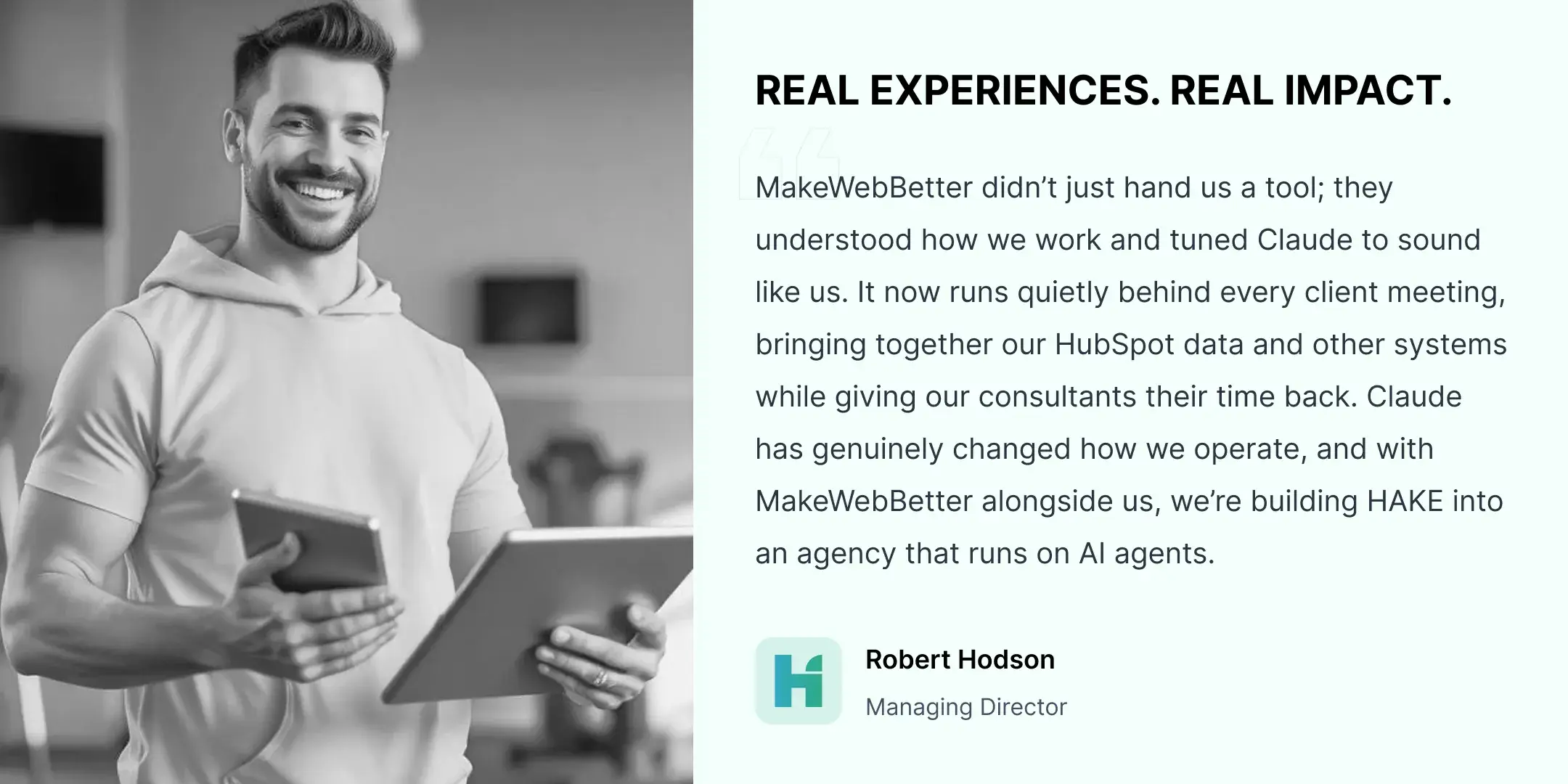
Let’s understand with a small example: HAKE Digital found their Claude-based Meeting Agent connects meeting recordings and summaries with other tools, turning meeting context into preparation briefs, draft documents, and structured action lists.
What makes MakeWebBetter different?
For businesses exploring Claude consulting, Claude implementation services, or the wider Claude Partner Network, you must start by learning about the opportunities you have with your Claude license. Consult with a certified Claude architect.
- Your business already has systems.
- Your teams already have workflows.
- Your data already exists.
- Your processes already have rules, exceptions, dependencies, and human judgment.
We bring those realities into the architecture.
Our Claude Partner Services span from identifying the opportunity to embedding intelligence into recurring processes.
That’s what we consider the role of a Certified Claude Architect. Not just understanding what Claude can do.
Understanding where it should work is much more important.
Powering AI Possibilities to Production
The next AI advantage won’t come from more experiments. It will come from putting intelligence in the right places.
- Inside the workflow.
- Inside the systems.
- Inside the decisions.
- Inside the experiences your teams and customers already use.
That’s what we mean when we say:
Powering AI Possibilities to Production. Ultimately, translated to AI adoption.
And that’s what it means to craft intelligence that lives in experience.