
An effective enterprise AI strategy for business goes beyond mere process redesign. When harnessed properly, AI today drives your capacity for innovation, competitive edge, business value for prospects, and broader enterprise scalability.
However, there are heavy prerequisites for artificial intelligence to work in a defined way and be genuinely useful. Its role and behavior must align with specific business objectives.
So, where do you start? This guide breaks down the essentials that help you identify and turn your AI opportunities into an actionable AI roadmap using a starter playbook.
What makes an effective enterprise AI strategy?
90% of businesses are using AI. The question is, how are they actually putting it to work?
For each business, an enterprise AI strategy changes even with the smallest differences in goals, workflows, or customer needs. Thus, there’s always a fine difference in approach.
On top of that, all of it involves pooling a huge amount of time and resources. This is why having a dedicated AI playbook as a roadmap helps define your path to an effective strategy.
Organizations achieving greater value with AI are more likely to:
- Redesign workflows using AI agents,
- pursue growth and innovation alongside efficiency, and
- Make broader organizational changes.
It is also evident in McKinsey’s State of AI and Gartner’s report.
How to Build an AI Strategy for Business?
No two businesses can implement AI the same way. But that doesn’t mean the path to an effective enterprise AI strategy has to be different every time.
There are already generally accepted frameworks, such as NIST’s AI Risk Management Framework, that demonstrate a common framework can drive AI adoption for different organizations without requiring identical solutions. The framework shared in this read gives you the structure, but your business determines the direction and approach.
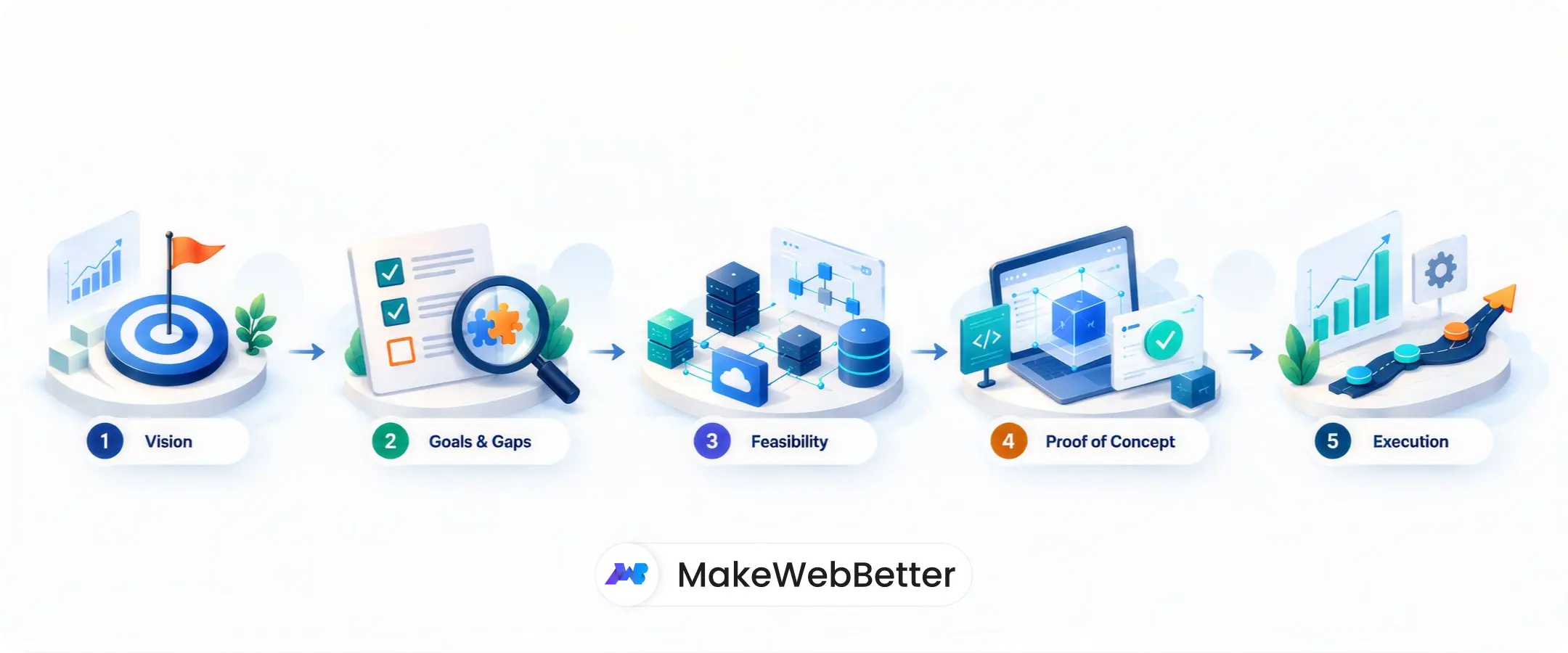
Every transformation starts with a vision: to improve, solve, and fulfill. You set your goals, identify gaps, test technical architecture, develop a proof of concept, and turn strategy into execution.
How practical is it to execute a template-based AI strategy for business?
A 2026 survey by WRITER found that 97% of executives deployed AI agents last year, while 52% of employees were already using them. Yet, adoption hasn’t guaranteed meaningful business outcomes. Three in four executives feel their AI is just a flashy, expensive thing and doesn’t deliver real growth.
Deploying AI in business systems and actually getting value out of it are two different things. You need a clear idea of:
- what you want AI to achieve,
- where it fits into your business, and
- How you’ll measure its impact.
That’s where an AI strategy playbook comes in.
The key to creating the playbook is knowing which questions to answer before committing to an AI solution. Moreover, it also helps you work through those questions.
AI Roadmap: Follow the Universal Approach to Process Redesign
Building a strategy for AI implementation is a classic spin-off of business process redesign, which only involves AI as the technology architecture.
Everything’s pretty much the same. It requires you to establish the organization’s goals, priorities, and risk management approach. The roadmap below outlines a way to translate this vision into actionable stages.
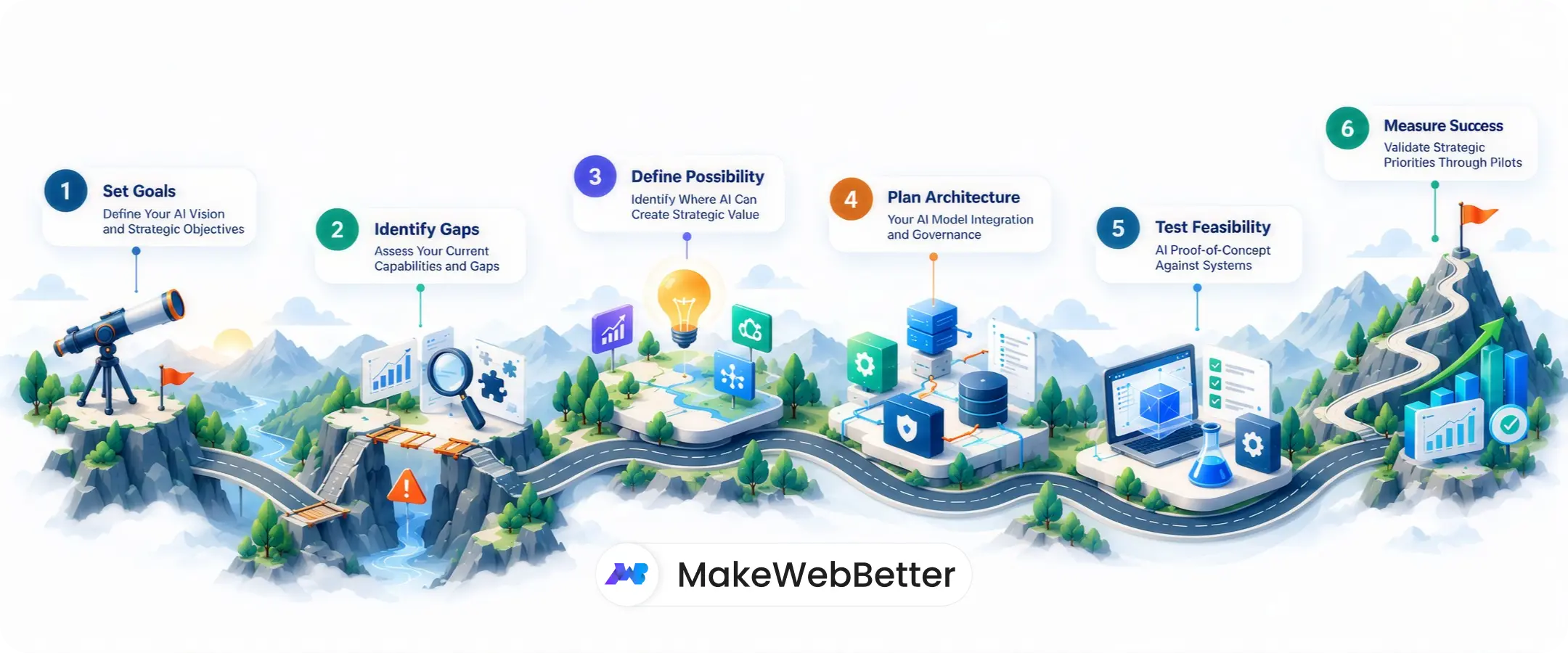
Set Goals: Define Your AI Vision and Strategic Objectives
Start small! Begin by tackling a common pain point within your business. Define what you want your organization to achieve and how AI can help meet broader strategic goals. This will ensure adoption by shaping your process redesign and overall AI implementation roadmap.
Identify Gaps: Assess Your Current Capabilities and Gaps
You already have an AI roadmap. It’s woven within your very business. Look for gaps by evaluating your current setup, including workflows, data, systems, and team capabilities. This way, you identify your own constraints that need to be addressed before AI implementation.
Define Possibility: Identify Where AI Can Create Strategic Value
After understanding the current infrastructure and gaps of your business, you can clearly foresee where AI can realistically add value. Understand how and where generative AI, predictive models, and agentic automation can maximize value.
Plan Architecture: Your AI Model Integration and Governance
Choose your AI solution and what model you want to use. Define what needs to be integrated, who owns it, who has access, and what controls are needed to ensure it can operate effectively. Consider when you would need human oversight.
Test Feasibility: AI Proof-of-Concept Against Systems
Determine how AI will fit into processes and test the proof of concept against existing systems, which includes the technical infrastructure, tools, data flows, team, and long-term business needs.
Measure Success: Validate Strategic Priorities Through Pilots
Ensure you have proven value. Test your redesigned processes against your defined outcomes. Understand the parameters of any performance gaps and use insights from real results to improve your strategy.
Real-World AI Strategy Tips & Tricks
From defining business objectives and identifying use cases to assessing technical requirements and planning implementation. This is your cheat sheet to foolproof your strategy.
Your Advantage: Cost, Speed, Quality, or Something New
Decide what AI should help your business do better—or make possible for the first time.
- Cost: Reduce operational expenses and manual effort.
- Speed: Shorten response times and utilize autonomous AI for repeat decisions.
- Quality: Improve accuracy, consistency, and customer experience.
- Innovation: Create new services, offerings, or ways of working.
Why: If AI doesn’t deliver a new business value or a competitive edge, then there isn’t a strategic benefit in using AI.
Redesign How Work Flows with AI
Don’t just automate existing tasks. Answer how AI executes processes that are initiated and completed. Identify which steps AI can handle, which can be removed, and where you can speed up decision-making.
Why: Automating individual tasks can deliver incremental gains. It can alter how and to what extent you achieve productivity. Ultimately, changing how you do business.
Decide What Intelligence Your Business Needs to Build
Think beyond individual AI tools. Identify the AI-powered intelligence your business can develop and reuse across processes and teams.
This could be knowledge, increased customer insight, forecasting, decision-making, or the ability to execute complex tasks.
Why: Without understanding the structure of AI, your AI implementation could be eating up credits for near-similar tasks or processes for duplicated outcomes.
Build for the Foundation, Not a Collection of Pilots
Treat successful AI implementations as building blocks for future initiatives.
Identify what can be copy-pasted for certain results. Most common examples include: AI-ready data pipelines, integrations, knowledge sources, evaluation methods, and governance controls. Decide when teams should use existing capabilities instead of building from scratch.
Why: You don’t waste effort; you harness the goodness of successful implementation and replicate success across. Plus, you get reduced duplication, simplified maintenance, and reduced cost and effort.
Determine What AI Must Know and What It May Do
Selecting what information and permissions AI needs to act are two different decisions.
- What AI must know: Business context, internal knowledge, customer data, policies, and relevant history.
- What AI may do: Retrieve information, recommend, update records, trigger workflows, or execute actions (with or without defined permissions).
Why: AI will produce irrelevant results. Absence of the right context and inadequate authority can create risks to your business.
Redefine Decision-Making and Accountability
Apart from deciding what decisions will be made by humans and what can be automated by AI.
Decide who decides, who acts, and who’s accountable when AI becomes part of the workflow. Don’t surrender control over your operations.
Why: AI can be very successful at completing a task while the overall business process still fails because right decision-making and ownership remain unclear.
Decide How You Will Capture and Reinvest AI Value
Efficiency gains only become business value when you decide what to do with them. Determine how an increased capacity will be used. Where will an AI insight be used?
You may reduce costs, increase the number of customers you can serve, improve quality, speed up delivery, or invest in new offerings.
Why: Without a plan to capture and reinvest the gains, AI may improve task-level efficiency without meaningfully improving business performance.
When Should You Consider AI Consulting?
AI consulting with experts can help you understand all the different opportunities available and make sure you’re set up to overcome any integration issues. This is great, especially if you have multiple teams involved or a complex system.
MakeWebBetter can help you with everything. Be it starting with your opportunity identification or developing a proof of concept, automation, systems, integration, or end-to-end implementation within your business.
We are a Claude Select Partner who helps you through every building block of AI implementation to make sure it fits well with your current operations.

Seeing opportunities but unable to decide?
Download the AI strategy playbook and claim your free AI Readiness Assessment to identify zero-down potential AI opportunities.
Frequently Asked Questions
What should an enterprise AI strategy include?
An effective strategy for AI implementation should:
- Start with objectives and goals
- Identify gaps and prioritize use-case-based fixes
- Test architecture readiness and the proof-of-concept
- Ensure governance and ownership
- Determine the key success metrics
How should you prioritize AI use cases?
Prioritize use cases based on their forecasted costs, measurable business impact, and likelihood of being able to deliver tangible benefits with care.
How long does AI implementation take?
This will depend on a variety of factors. You can narrow it down to the challenges & risks, use case, data quality, and integration complexity. Obviously, a pilot implementation could be quicker than an enterprise-wide solution.
What are the common mistakes to avoid in building an AI strategy?
In a nutshell, the biggest mistakes to avoid while developing an AI strategy are:
- Choosing the tools before the business problem.
- Assuming the organization is equally prepared for each use case.
- Underestimating data prep and system integration.
- Scaling pilots without testing actual performance.
- Measuring usage instead of business outcomes.
- Governance as an afterthought.
- You’re introducing agentic AI where simple automation would have done.