
2025 marked an accelerated pace for AI integration into core business operations. AI CRM tops this list as #1 in AI adoption for the 2026 business growth strategy.
The competitive market landscape compels organizations to equip their teams with AI capabilities for operational upkeep and greater efficiency. 3 out of 4 executives believe AI implementation will directly contribute to their organization’s growth.
92.1% of businesses say they got measurable results from AI adoption. Thus, AI-powered CRM is a must-have in the 2026 business growth strategy roadmap.
Let’s learn more about the AI implementation and AI CRM strategy.
Transitioning to an AI-powered CRM System
Meanwhile, AI Adoption has also exposed the weakest link of business systems, ‘fragmented data’. It’s laborious work, and enabling AI CRM tools is no exception here!

With AI already central to your 2026 business growth strategy, the right push with the right data becomes the differentiator.
For AI-powered CRM, you need more than that. Your dream AI CRM tools would require a clear operational structure, on top of quality data, for the artificial intelligence to be both impactful and reliable as a copilot.
Moreover, if you have a fragile setup with fragmented data, AI amplifies them rather than correcting them. Hear it from a HubSpot user who has done it:
In our experience, the biggest shift with AI in HubSpot was moving from static CRM fields to behavior-driven context. We trained AI layers on real customer signals and fed them back as live enrichment so teams could act on why accounts stalled. The main challenge was data hygiene: AI amplified every inconsistency, so ownership rules and event tracking had to be fixed first. Thus, treat AI adoption as a forcing function to clean workflows, standardize lifecycle stages, and define what a successful customer actually looks like.
Roman Milyushkevich, CTO at HasData
There’s your clear vision for the AI implementation roadmap!
AI CRM strategy begins with context, not capability.
CRM Readiness comes before AI CRM Strategy
It may sound like a simple integration, but here’s what it means in practice.
An effective AI CRM strategy depends on well-defined processes, details & data, not just configuring some tools for AI implementation.
This starts with setting a clear goal.
Strategy & Intent → Structure & Logic → Data Readiness → AI Enablement
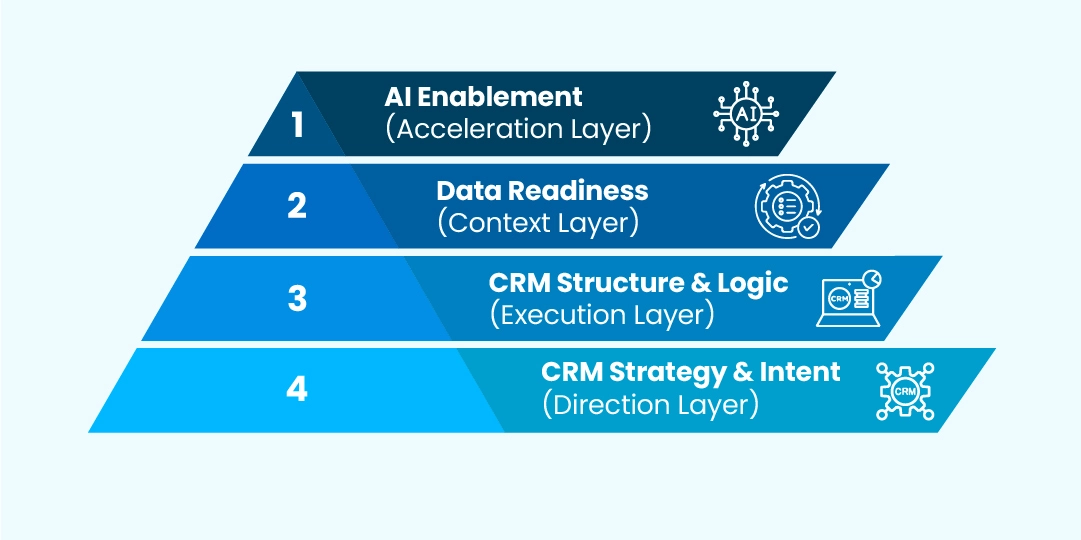
Be clear on what the AI-powered CRM is expected to do:
- who should be prioritized,
- when action is required, and
- what success looks like at each lifecycle stage.
All before AI even enters the frame.
Ask yourself: You’re setting goals for a new C-suite manager for your company. Before they join, you’re clear on priorities, expectations, and outcomes. Only that the person is yet to arrive, expects some garlands, and talks about how they are highly adaptive and have impeccable learning capabilities. What briefing would they need?
We are HubSpot AI & Breeze Certified!
MakeWebBetter, HubSpot Elite Solutions Partner, is certified in HubSpot’s Breeze AI and AI Implementation programs. The MakeWebBetter team brings practical expertise in embedding your AI CRM strategy, powering AI-driven automation and HubSpot Smart CRM capabilities.
With hands-on experience of HubSpot Breeze and AI implementation, we help businesses:
- Navigate high-impact AI use cases for them instead of chasing AI trends.
- Design AI-powered CRM workflows in their existing HubSpot setup.
- Introduce scalability in their processes alongside intelligence.
- Enhance lead management, personalization, and forecasting.
- Build a data-backed system with AI insights across operations & processes.
Structured AI Adoption Made Easy
Recently, we introduced an intuitive, quick-to-launch AI implementation platform, MakeWebBetter Connect.
Why should you care? Connect offers deep HubSpot CRM logic with prebuilt AI workflow templates, HubSpot integration apps, account objects, and all-embracing AI CRM tools. It complements your business growth strategy like no other, ‘AI + Automation + No-Code Integration + HubSpot.’
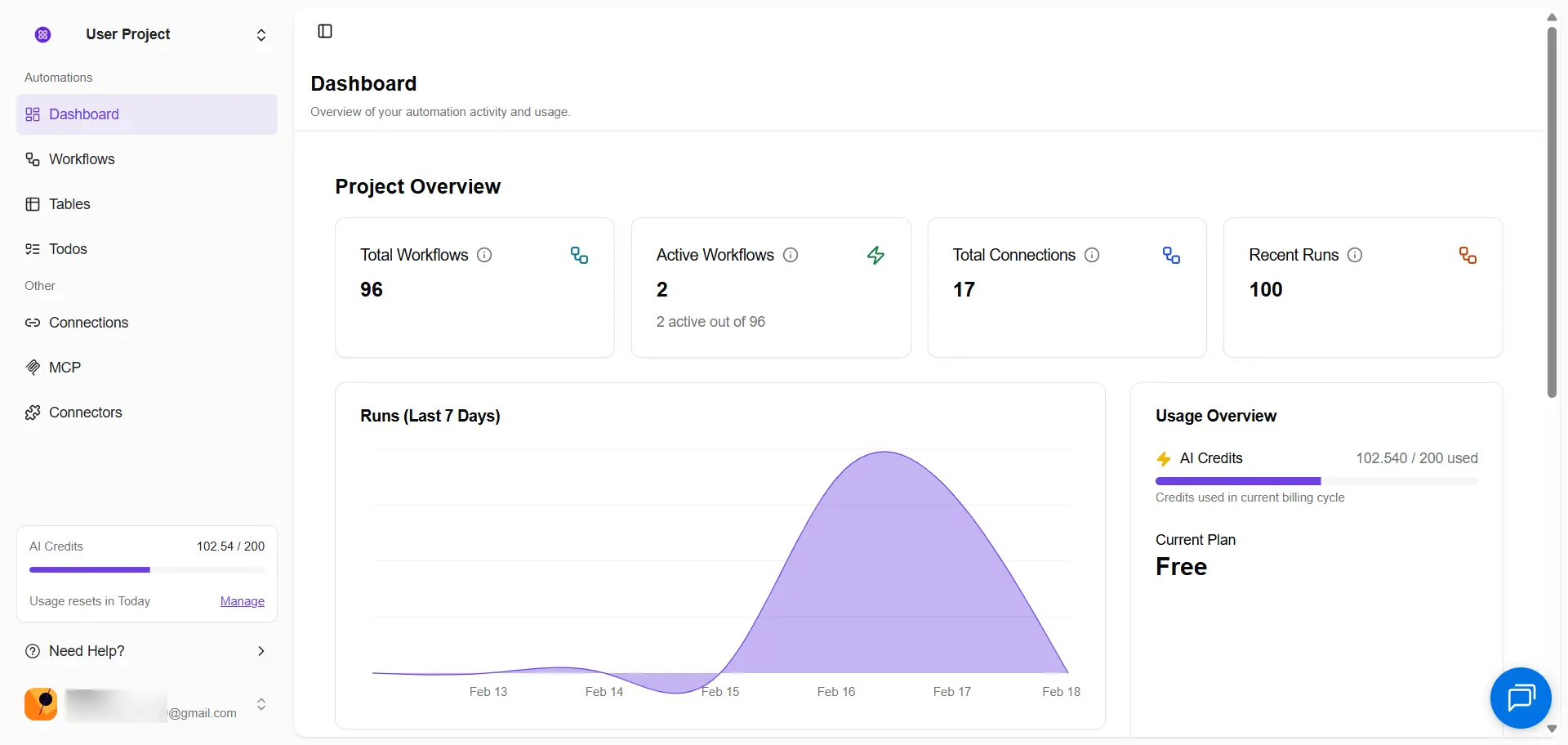
Furthermore, MakeWebBetter Connect brings together all the essentials to implement AI in CRM and overall AI adoption.
- MCP servers to bridge AI models (like ChatGPT, Agent.AI, Perplexity, etc.) and external data sources or tools. The most crucial to arrive at the CRM with AI.
- 400+ connectors for cross-platform data integration.
- Dedicated workflow builder with customizable templates.
- Todos for Human-in-the-loop offering an approval system for AI-driven automation.
You can get started with the Free Forever plan (200 AI credits & Unlimited AI Agents) to test alignment with your business objectives and implement agentic automation at scale. If you want to know more about it, choose a slot for a free demo.
How to implement AI in CRM with Business Intent
Once you’re clear on what your AI-powered CRM is expected to achieve, that intent must be translated into CRM structure. You can skip to preparing the AI-ready data first and then define the CRM structure. But it’s recommended to start with data when implementing AI in CRM and redefining your business growth strategy.
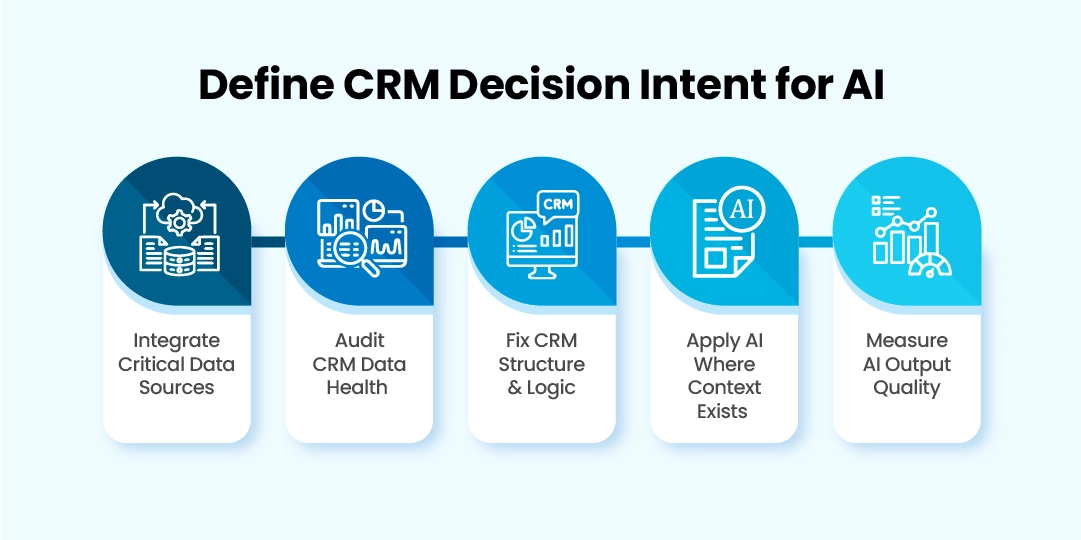
Integrate Critical Data Sources
Unify the data and build an ecosystem for your desired CRM with AI, where all your data lives. In a nutshell, centralize critical data. Ultimately, your CRM data quality will achieve context-driven decision-making.
- Sync only Business-critical Systems: Marketing tools, payments, website, support, RevOps tools, and your crucial business systems.
- Integrate only what adds Decision Context: Behavioral data, interaction data, transactional data, demographics & firmographics data.
- Ensure consistency, Not Volume: Standardize naming conventions, data formats, and the same syntax across every form & field. Don’t recreate data every time.
- Enforce a Single Source of Truth: ‘Everybody sees the same data across systems.’ For instance, ensure that the sales & support teams are on the same page.
Audit CRM Data Health
Once you succeed in accumulating all the data and move towards the ideal CRM with AI. As the next step, scrutinize and quality check the data for gaps and inconsistencies. Validate the reporting accuracy of the data you have at this stage.
- Scrutinize and Quality Check for Gaps: Identify missing “must-have” fields (like email, contact, or lead generation source) and purge duplicate records.
- Validate Reporting Accuracy: Cross-reference your CRM dashboards. Match revenue report with sales dashboard, marketing-sales leads to leads follow-ups, and so on.
- Establish a “Data Decay” Protocol: Know that data goes stale. Set up a regular cleanup routine, so your team doesn’t chase ghost leads over outdated contact info.
- Align Data to the Buyer Journey: Track every stage, not just the start and end. Ascertain why deals move forward and, more importantly, exactly why they are lost.
Design CRM Structure & Logic
Align everything! Start with your business goals & data flow, and move to RevOps, automation, lead routing, lifecycle stages, and operations, built within a connected, cross-functional CRM structure.
- Structured Data & Scalable Processes: Design objects, properties, & associations that match your process automation.
- Cross-functional Ops: Keep RevOps (marketing, sales, support) and operations in sync, boosting CRM logic across the processes, without data silos.
- Clear Lifecycle-Ownership: Define stages, qualification criteria, lead routing, handoffs, & ownership to ensure effective engagement.
- Proactive Decision-making: Enable accurate tracking of pipeline, attribution, and performance to drive faster, more informed decisions.
Apply AI Where Context Exists
Utilize AI in CRM for its general intelligence first.
Align the AI adoption in workflows with basic processes. Iterate, optimize, and implement your business logic to prevent unreliable outputs for high-impact cases & processes.
- AI-enhanced Operations: Deploy AI for summarisation, prioritisation, and forecasting alongside reliable data and clear context.
- Controlled Application of AI: Apply AI to measurable and low-risk operations to drive confident adoption and long-term scalability.
- Validate AI against Real-world Cases: Constantly compare AI outputs with desired business outcomes and refine AI logic based on findings.
Measure AI Output Quality
Test how it performs. Scrutinize the logic your AI leverages, the process it follows to arrive at the next-best action. Your initial parameters can be: Accuracy, relevance, and trust.
Next, refine CRM logic. If AI outputs feel wrong, examine the data, and then refine the logic.
This layer is not about CRM configuration at all. It is about building your business logic in CRM with AI.
Where AI Fits — And Where It Doesn’t
AI works best when it operates within a well-designed system.
If you’re in the process of adopting AI CRM tools, you likely expect sharper insights, better forecasting, & faster decision-making.
Surely, AI can summarize activity, highlight priorities, and surface insights.
When AI is layered on top of data chaos, the result isn’t intelligence—it’s accelerated misalignment. A realistic AI CRM strategy for 2026 doesn’t start with tools, copilots, or AI-driven automation promises. It starts with data readiness.
When applied deliberately, AI in CRM strengthens execution instead of redefining it.
→
Bottom Line
The uncomfortable reality most teams overlook: Artificial Intelligence doesn’t compensate for poor CRM foundations—it magnifies them. So, you work your way upstream and then optimise it downstream, based on outcomes. Ultimately, achieving a sustainable business growth strategy.
You now know that data discipline is the real differentiator and a well-defined CRM structure is the essential that works towards a successful AI CRM strategy.
In a nutshell: You must ensure AI in CRM aligns with your intent. Then enforce structure and stabilize the data. Only after that does AI become a meaningful accelerator rather than a source of noise.
Let’s cut the workarounds and weave AI into your automation and system. Feel free to share your thoughts.